
Does EMDR Work for Trauma? An Honest Look at the Research.
by Kevin Becnel, LPCC, kevinbecnel.comDoes EMDR Work for Trauma? An Honest Look at the Research.
The short answer: EMDR is an evidence-based therapy for trauma and PTSD. The World Health Organization, the U.S. Department of Veterans Affairs and Department of Defense, and the UK’s NICE all recommend it in their treatment guidelines, and it significantly reduces symptoms for many people. It performs comparably to other leading trauma therapies, though it isn’t right for everyone.
If you’re reading this, possibly something from the past has stayed with you. Maybe your mind keeps returning to an event, or your body carries a feeling that doesn’t match the safety of your present life. Maybe people have told you it’s “in the past,” and yet it doesn’t feel like the past at all.
I want to start by saying that nothing is wrong with you for feeling this way. Trauma isn’t a character flaw. It happens when an experience overwhelms the nervous system’s ability to process it. And people ask me one question more than any others: Can EMDR help?
So, does EMDR actually work?
For many people, yes. EMDR (Eye Movement Desensitization and Reprocessing) is one of the most studied therapies for PTSD, and the World Health Organization, the U.S. Department of Veterans Affairs and Department of Defense, and the UK’s National Institute for Health and Care Excellence, among others, recommend it in their treatment guidelines. A 2014 meta-analysis that pooled 26 randomized controlled trials found that EMDR significantly reduced PTSD symptoms, along with associated depression and anxiety.
I also want to be straight with you about the nuance, because you deserve the whole picture. The American Psychological Association’s 2017 guideline gave EMDR a more cautious rating than some other trauma therapies, and some researchers have argued that rating underweighted the available data. Head-to-head comparisons generally find EMDR performs comparably to trauma-focused cognitive behavioral approaches. In other words, the evidence says EMDR is a well-supported option. It doesn’t say that EMDR is the only one, and it doesn’t say it works for everyone.
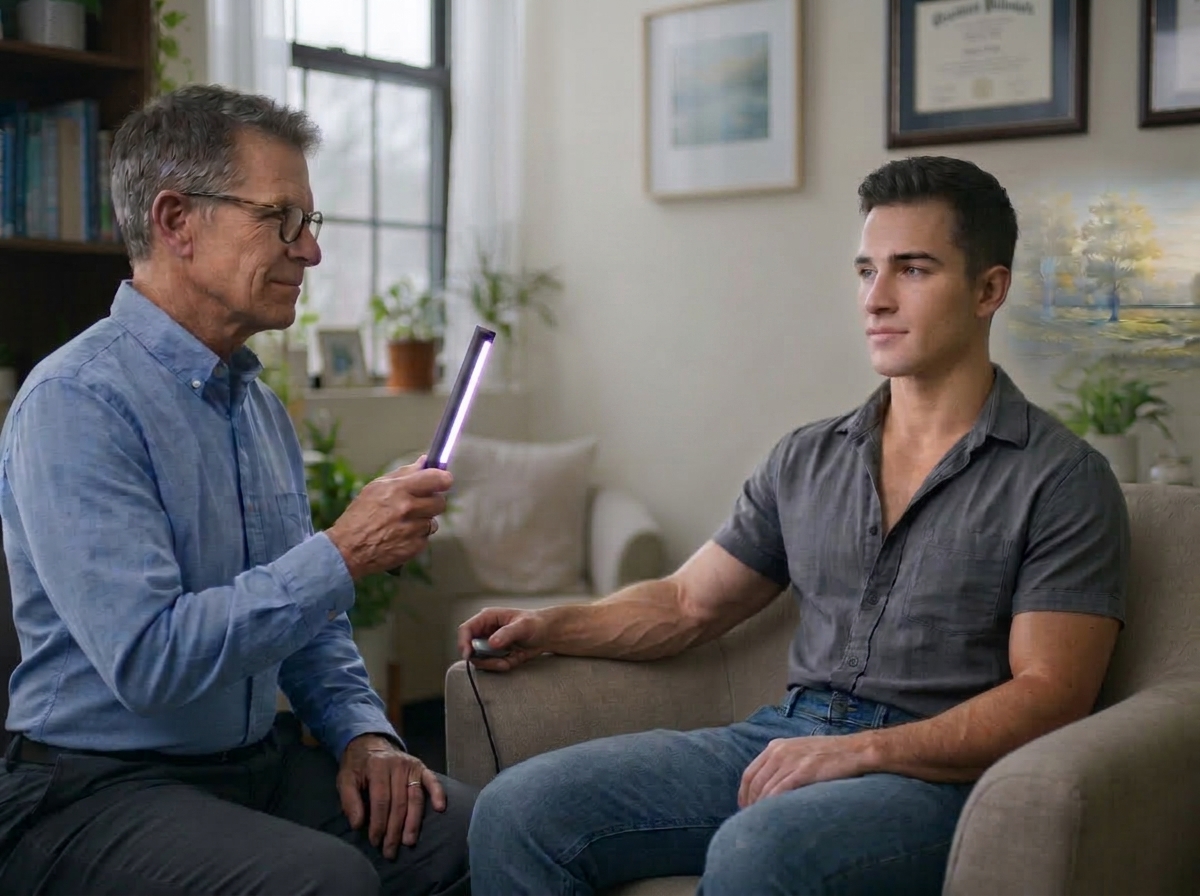
What is EMDR, in plain language?
Psychologist Francine Shapiro developed EMDR in the late 1980s. In a session, you bring a distressing memory to mind in small, manageable pieces while your attention is gently guided back and forth, most often through side-to-side eye movements, though some therapists use tapping or alternating tones instead.
EMDR does not hypnotize you. You stay awake, aware and in control. You don’t have to narrate every painful detail out loud. For many people, that last point matters enormously, because the thought of retelling the worst moment of their life is exactly what keeps them from seeking help.
How might it work?
The honest answer is that researchers are still debating this.
The most common explanation is that holding a difficult memory while also attending to something in the present gives the brain a kind of dual focus. This may make the memory less vivid and less emotionally charged, so it can be stored as something that happened rather than something that is happening. Some studies suggest the eye movements themselves add benefit, and others suggest much of the effect comes from the careful, structured way the therapist and client revisit the memory. I find it reassuring to say this out loud: we don’t need to fully understand why a door opens to be grateful that it does.
What many people describe is that the memory is still there, but its grip loosens. They can remember without reliving.
What does the process actually look like?
EMDR is not a single dramatic moment. It follows a structured sequence, and the first part is often the most important.
- Getting to know you. We talk about your history, your goals and what you are hoping will change.
- Preparation. Before touching anything painful, we build tools that help steady yourself: grounding, breath, a sense of safety in your body. In my work I never rush this, because a nervous system that feels unsafe can’t heal.
- Reprocessing. Together, we work with a targeted memory at a pace you can tolerate, checking in often.
- Closing and integration. Every session ends with you feeling grounded and steady enough to walk back into your day.
How long it takes varies. A single-incident trauma may shift in a relatively small number of sessions. Developmental or repeated trauma usually asks for more time and more preparation, and that’s not a sign of failure. The work simply requires it.
Is EMDR right for everyone?
No, and I’d be doing you a disservice if I said otherwise.
Reprocessing can bring up strong emotions, and some people feel tired or tender in the days after a session. If you’re in the middle of a crisis, using substances heavily to cope, or struggling with significant dissociation, we will need to build stability first. Some people simply connect better with a different approach, and that’s perfectly okay. The best therapy is the one you can actually engage with, with a clinician you trust.
It’s also worth asking any therapist about their training. Look for someone who has completed a recognized EMDR training and who can tell you how they pace the work.
What I want you to know
Trauma tells a particular story: that you’re stuck, that this is just who you are now, that things won’t change. The research tells a different one. People recover from trauma, including people who have carried it for decades. Healing doesn’t mean erasing what happened. It means the past stops running the present.
If you’re considering EMDR, or wondering whether it might be a fit, I’d be glad to talk it through with you. You don’t have to have the right words or know exactly what happened. You only have to be willing to take one small step.
If you are in crisis or thinking about harming yourself, please reach out right away. In the U.S., you can call or text 988 to reach the Suicide & Crisis Lifeline. This article is for general education and isn’t a substitute for individual care.
Quick answers
Is EMDR effective for PTSD? Yes, for many people. It is recommended in major international treatment guidelines and supported by numerous randomized trials.
Do I have to talk about the trauma in detail? Not necessarily. EMDR can be done without describing every detail aloud.
How many sessions will I need? It depends on the type and complexity of the trauma and your starting point. Some people notice change within a handful of sessions, while complex trauma usually takes longer.
Is it safe? It is generally considered safe when delivered by a trained clinician at an appropriate pace, though it can stir up strong feelings along the way.
Is EMDR better than other trauma therapies? The evidence suggests it’s comparable to other leading trauma-focused treatments. The right choice depends on you.
Sources
- Recent research on EMDR therapy (EMDR International Association): lists the WHO, VA/DoD, NICE and ISTSS guidelines and recent trials.
- Errors in the 2017 APA Clinical Practice Guideline for the Treatment of PTSD (PubMed Central): a critique of how that guideline rated EMDR.
- EMDR research overview: summarizes the 2014 meta-analysis of 26 randomized trials and earlier guideline reviews.
Last reviewed .
About the author
Kevin Becnel, LPCC is a holistic psychotherapist. To learn more about his work or to start a conversation, visit kevinbecnel.com.